
The India e-Visa is an electronic travel authorization that allows foreign nationals to enter India for tourism, business, medical treatment, or attending conferences – without visiting an embassy or consulate. Since its launch in 2014, the system has streamlined entry for millions of travelers from over 160 eligible countries.
This comprehensive guide covers every aspect of the India e-Visa: types, eligibility, application process, required documents, fees, processing times, common mistakes, and expert tips to ensure your application is approved without delays.
What Is the India e-Visa?
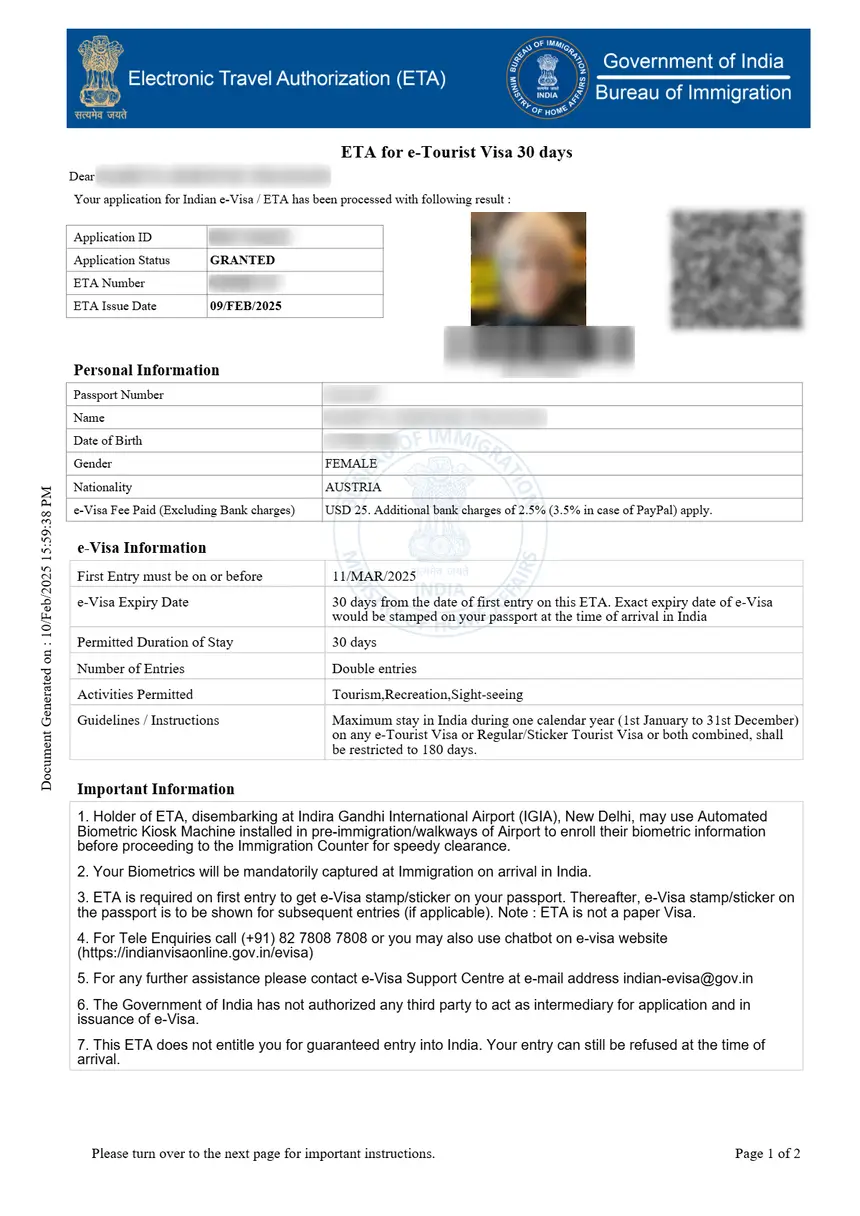
The India e-Visa (electronic visa) is an official document issued by the Bureau of Immigration, Government of India. It grants permission to travel to and enter India through designated airports and seaports. Unlike a traditional visa stamped in your passport, the e-Visa is applied for entirely online, processed digitally, and delivered to your email as a PDF.
The e-Visa system was introduced to simplify the visa process, reduce wait times at embassies, and promote tourism and business travel to India. It replaced the earlier Visa on Arrival (VoA) system and expanded eligibility to cover a much larger number of nationalities.
Key facts about the India e-Visa:
- Entirely online application – no embassy visits required
- Available to citizens of 160+ countries
- Delivered by email as an ETA (Electronic Travel Authorization)
- Must be obtained before departure – it is not available on arrival
- Valid for entry through 28 designated airports and 5 seaports
Types of India e-Visa
India offers five distinct e-Visa categories, each tailored to a specific purpose of travel. Choosing the correct type is critical – using the wrong category can result in denial of entry or future visa complications.
1. e-Tourist Visa
The e-Tourist Visa is the most commonly issued category. It is designed for foreign nationals visiting India for sightseeing, recreation, casual visits to friends or family, or attending a short-term yoga program.
Validity options:
– 30-day e-Tourist Visa: Double entry, valid for 30 days from the date of arrival in India.
– 1-year e-Tourist Visa: Multiple entry, valid for 365 days from the date of grant of ETA.
– 5-year e-Tourist Visa: Multiple entry, valid for five years from the date of grant of ETA.
Important: The 30-day e-Visa has a window of arrival – you must enter India within 120 days from the date of issue. The 1-year and 5-year variants allow entry at any time within their validity period.
2. e-Business Visa
The e-Business Visa is intended for travelers coming to India for business-related activities such as attending meetings, exploring business opportunities, setting up industrial ventures, conducting tours, delivering lectures under the Global Initiative for Academic Networks (GIAN), or recruiting manpower.
Validity: 365 days from the date of grant, with multiple entries allowed.
Maximum stay: 180 days in a single calendar year. If you need to stay longer, you must register with the Foreigners Regional Registration Officer (FRRO).
3. e-Medical Visa
The e-Medical Visa is for foreign nationals seeking medical treatment at recognized or specialized hospitals and treatment centers in India. India’s medical tourism industry is a major draw, offering world-class healthcare at significantly lower costs compared to Western countries.
Validity: 60 days from the date of arrival, with triple entry permitted.
4. e-Medical Attendant Visa
This visa is issued to up to two attendants or family members accompanying an e-Medical Visa holder. The attendant visa is tied to the primary medical visa holder’s application.
Validity: 60 days from the date of arrival, with triple entry.
5. e-Conference Visa
The e-Conference Visa is for foreign nationals attending conferences, seminars, or workshops organized by a government body, a government-affiliated organization, or a recognized institution in India.
Validity: 30 days from the date of arrival, with single entry.
Who Is Eligible for the India e-Visa?
Citizens of over 160 countries are eligible to apply for an India e-Visa. The most common eligible nationalities include:
Americas: United States, Canada, Brazil, Argentina, Mexico, Colombia, Chile
Europe: United Kingdom, Germany, France, Italy, Spain, Netherlands, Sweden, Poland, Norway, Switzerland
Asia-Pacific: Australia, New Zealand, Japan, South Korea, Singapore, Thailand, Malaysia, Philippines
Middle East & Africa: UAE, Saudi Arabia, Israel, South Africa, Nigeria, Kenya
Notable exceptions: Citizens of Pakistan are not eligible for e-Visa and must apply through the traditional embassy route. Chinese nationals (mainland China) face additional restrictions depending on current bilateral policies. Citizens of certain African and Central Asian nations may also be excluded – always check the latest eligibility list on the official portal.
India e-Visa Requirements and Documents
Preparing your documents correctly before starting the application is the single most important step. Incomplete or incorrect documentation is the leading cause of e-Visa rejections.
Passport Requirements
- Your passport must be valid for at least 6 months from the date of arrival in India.
- The passport must have at least two blank pages for stamping at immigration.
- Diplomatic and official passport holders are not eligible for e-Visa – they must apply through embassy channels.
Photo Requirements
- Recent passport-style photograph, taken within the last 6 months.
- Dimensions: 2 inches × 2 inches (51mm × 51mm), square format.
- Background: Plain white or light-colored background.
- Format: JPEG file, between 10 KB and 1 MB in size.
- Quality: Full face, front view, eyes open, no glasses (unless medically necessary), neutral expression.
Additional Documents by Visa Type
e-Tourist Visa:
– Scanned copy of passport’s bio page (PDF, 10 KB – 300 KB)
– Return or onward flight ticket (recommended but not always required)
e-Business Visa:
– Scanned copy of passport bio page
– Business card or company letterhead with details
– Invitation letter from the Indian company or organization
– Copy of the Indian company’s registration documents
e-Medical Visa:
– Scanned copy of passport bio page
– Letter from a recognized Indian hospital confirming the treatment plan
– Details of the medical condition and proposed treatment
e-Conference Visa:
– Scanned copy of passport bio page
– Invitation letter from the conference organizer
– Political clearance from the Ministry of External Affairs (for certain conferences)
How to Apply for India e-Visa: Step-by-Step
The application process is straightforward but requires attention to detail. Follow these steps carefully:
Step 1: Visit the Official Portal
Go to the official Indian government e-Visa website: indianvisaonline.gov.in. This is the only legitimate portal. Avoid third-party websites that charge excessive service fees.
Step 2: Select Your e-Visa Type
Choose the appropriate visa category based on your purpose of travel. Once selected, you cannot change the type without submitting a new application.
Step 3: Fill in the Application Form
Complete all fields accurately. You will need to provide:
- Full name (exactly as it appears on your passport)
- Date and place of birth
- Nationality and passport number
- Parents’ names and nationalities
- Marital status
- Current occupation and employer details
- Travel details: expected port of arrival, expected date of arrival
- Previous India visa details (if any)
- Countries visited in the last 10 years
- Reference contacts in India (hotel name or personal contact)
Critical tip: Every detail must match your passport exactly. Even minor spelling discrepancies between your application and passport can cause rejection.
Step 4: Upload Documents
Upload your photograph and passport bio page scan according to the specified formats and sizes. The system will reject files that do not meet the requirements.
Step 5: Pay the Fee
Fees vary by nationality and visa type. Payment is made online via credit card, debit card, or PayPal. The fee is non-refundable regardless of the application outcome.
Fee structure (approximate, subject to change):
– 30-day e-Tourist Visa: $10-$25 USD (depending on nationality and season)
– 1-year e-Tourist Visa: $40 USD
– 5-year e-Tourist Visa: $80 USD
– e-Business Visa: $80 USD
– e-Medical Visa: $25 USD
– e-Conference Visa: $25 USD
Some nationalities are exempt from the visa fee entirely, while others pay a reduced rate. Citizens of Japan, South Korea, and Mongolia, for instance, may receive preferential treatment.
Step 6: Receive Your ETA
After submission, you will receive an Application ID. Processing typically takes 72 hours, though it can be faster (12-24 hours) or slower (up to 5 business days) depending on the season and your nationality.
Check your application status on the portal using your Application ID and passport number. Once approved, the ETA will be sent to your registered email address as a PDF document.
Step 7: Travel to India
Print the ETA and carry it with your passport. At the Indian airport, proceed to the dedicated e-Visa counter where immigration officers will verify your ETA, take biometric data (fingerprints and photograph), and stamp your passport.
India e-Visa Processing Times
Processing times vary based on several factors:
- Standard processing: 72 hours (3 business days)
- Peak season (October-March): May take up to 5 business days
- National holidays and weekends: Processing pauses – plan around Indian national holidays
- Incomplete applications: Additional time for requests for supplementary documents
Expert recommendation: Apply at least 7-10 business days before your intended travel date to account for any unexpected delays. The application window opens 120 days before arrival for the 30-day visa.
Common Reasons for e-Visa Rejection
Understanding why applications get rejected helps you avoid the same mistakes:
- Passport validity less than 6 months from the date of arrival
- Photo does not meet specifications – wrong size, background, or quality
- Name mismatch between application and passport (even one letter)
- Incorrect passport number or wrong passport type selected
- Previously overstayed in India or violated visa conditions
- Criminal history or being on a watchlist
- Applying for the wrong visa category for your actual purpose of travel
- Duplicate applications – submitting more than one application simultaneously
If your application is rejected, you can reapply with corrected information. There is no formal appeal process for e-Visa denictions, but you may apply for a regular visa through the nearest Indian embassy.
Entry Points: Where Can You Use the India e-Visa?
The e-Visa is accepted at the following 28 designated airports:
Ahmedabad, Amritsar, Bagdogra, Bengaluru, Bhubaneswar, Calicut, Chennai, Chandigarh, Cochin, Coimbatore, Delhi, Gaya, Goa (Dabolim), Goa (Mopa), Guwahati, Hyderabad, Jaipur, Kannur, Kolkata, Lucknow, Madurai, Mangalore, Mumbai, Nagpur, Port Blair, Pune, Tiruchirapalli, Trivandrum, and Varanasi.
5 designated seaports:
Mumbai, Goa (Mormugao), Cochin, Chennai, and Mangalore.
You cannot enter India through a land border crossing with an e-Visa. For overland entry from Nepal, Pakistan, Bangladesh, or Myanmar, you need a traditional visa.
India e-Visa vs. Traditional Visa: When to Choose Which
The e-Visa is convenient but not always the right choice. Here’s a comparison:
Choose a traditional visa if:
– You plan to enter India via a land border
– You need to work or study in India
– You plan to stay longer than 90 consecutive days
– Your nationality is not eligible for e-Visa
Tips for a Successful India e-Visa Application
Based on thousands of traveler experiences, here are proven tips:
- Apply early. Don’t wait until the last minute. Apply at least 10 days before travel.
- Use the official portal only. Third-party sites often charge $100+ in unnecessary service fees.
- Double-check every field. A single typo in your passport number or name will cause rejection.
- Prepare your photo correctly. Use a professional photo service or follow the specifications precisely.
- Keep your Application ID safe. You need it to check status and download the ETA.
- Print the ETA. While immigration can verify digitally, a printed copy avoids potential issues.
- Check your email spam folder. The ETA email sometimes gets filtered as spam.
- Ensure passport validity. Count 6 months forward from your planned arrival date.
- Don’t overstay. Overstaying an e-Visa results in fines, deportation, and potential future visa bans.
- Carry supporting documents. Hotel bookings, return flights, and sufficient funds may be asked at immigration.
Extending Your India e-Visa
The e-Visa is generally not extendable and not convertible to another visa type. The 30-day tourist e-Visa cannot be extended under any circumstances.
For the 1-year and 5-year e-Tourist e-Visas, while the visa validity is long, the maximum continuous stay is typically 90 days per visit (180 days for US, UK, Canadian, and Japanese nationals). You must exit and re-enter to reset your stay.
In rare emergency cases (medical emergencies, flight cancellations due to natural disasters), you may approach the nearest FRRO for a short-term extension. These are granted on a case-by-case basis and are not guaranteed.
Frequently Asked Questions
Can I apply for an India e-Visa if I hold dual nationality?
Yes, but you must apply using the passport you intend to travel with. If you hold an OCI (Overseas Citizen of India) card, you do not need a visa at all.
Can I work in India on an e-Visa?
No. The e-Visa does not permit employment. You need an Employment Visa or appropriate work authorization.
What happens if my e-Visa expires while I’m in India?
You must leave India before the e-Visa expires. Overstaying is a serious offense that can result in fines, detention, deportation, and being barred from future entry.
Can I visit restricted or protected areas with an e-Visa?
Some areas in India (parts of Arunachal Pradesh, Sikkim, Andaman Islands, certain border regions) require a Protected Area Permit (PAR) or Restricted Area Permit (RAP) in addition to your visa. The e-Visa alone is not sufficient for these regions.
Is travel insurance required?
While not mandatory for the e-Visa application, travel insurance is strongly recommended. India’s healthcare system varies significantly by region, and medical evacuation can be extremely expensive.
Can I enter India multiple times on a 30-day e-Visa?
Yes, the 30-day e-Tourist Visa allows double entry. You can leave India and return within the 30-day validity period.
Stay Updated
India’s e-Visa policies are subject to change. The government periodically updates eligible nationalities, fees, validity periods, and entry requirements – especially in response to global events, diplomatic changes, or public health situations.
Always verify the latest requirements on the official portal (indianvisaonline.gov.in) before applying. Bookmark this guide for reference, and check back regularly for updates on policy changes that may affect your travel plans.