
The India Digital Arrival Card (also called the e-Arrival Card or ED Card) is an electronic form that all foreign nationals must complete before entering India. It replaces the traditional paper arrival/departure card that airlines and immigration desks used to hand out on flights. You fill it out online, and immigration officers verify it electronically when you land.
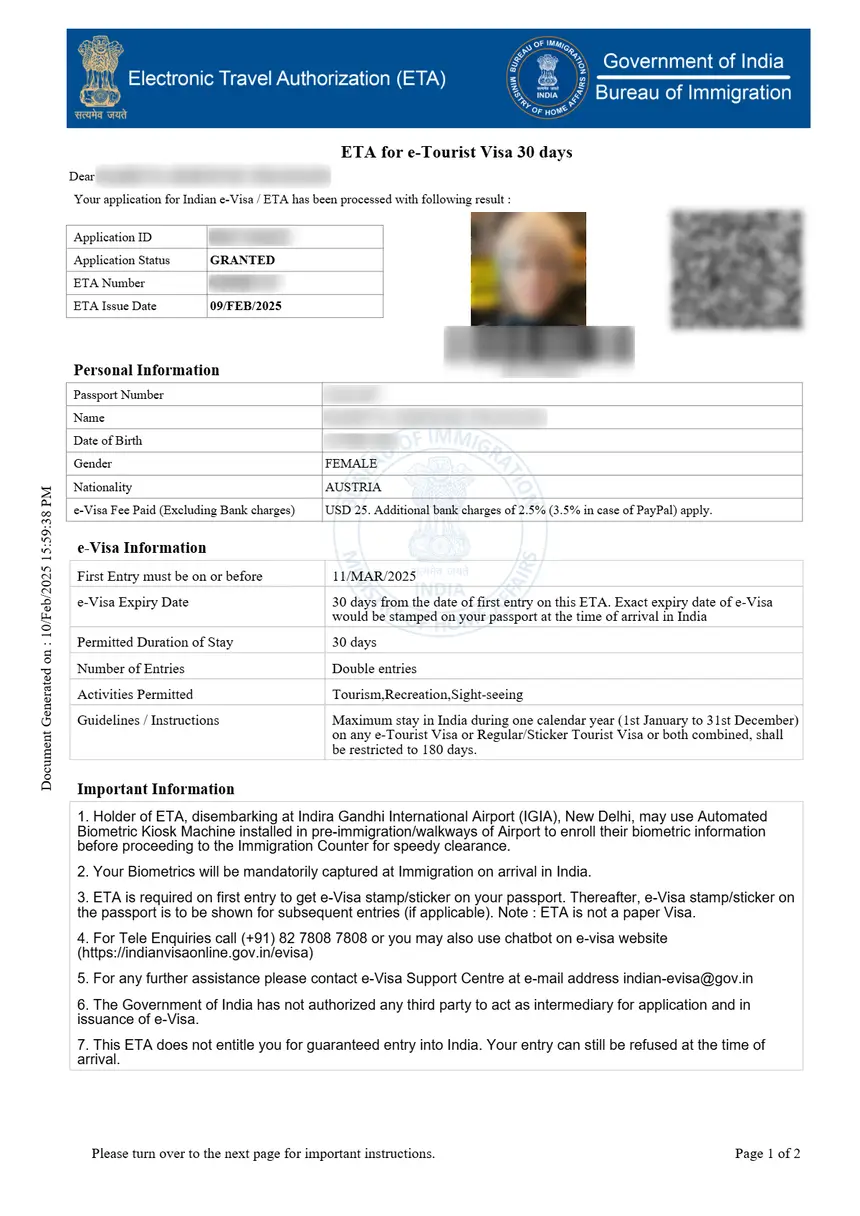
Every traveler entering India needs two things: a valid visa (or e-Visa) and a completed digital arrival card. The visa authorizes your travel; the arrival card records your trip details for immigration and customs. This guide explains what the e-Arrival Card is, how to fill it out, what information you need, and how it differs from the India e-Visa.
What Is the India Digital Arrival Card?
The Digital Arrival Card is India’s electronic replacement for the traditional paper-based disembarkation card (ED Card). Previously, flight attendants would hand out small paper forms during the flight, and travelers had to fill them in by hand before reaching the immigration counter. India’s Bureau of Immigration has modernized this process by moving the entire form online.
The digital version collects the same information as the paper form, but you complete it through the official portal at indianvisaonline.gov.in before your trip. Once submitted, your data is stored electronically and linked to your passport number. When you arrive at an Indian airport or seaport, the immigration officer scans your passport and pulls up your digital arrival card automatically.
This system reduces wait times at immigration counters, eliminates errors from illegible handwriting, and helps the Bureau of Immigration process large volumes of travelers more efficiently. It is part of India’s broader push to digitize border control, alongside the e-Visa system and the automated passport gates now available at major airports.
e-Arrival Card vs e-Visa: What Is the Difference?
Many travelers confuse the Digital Arrival Card with the e-Visa, but they serve different purposes:
| Feature | Digital Arrival Card | India e-Visa |
|---|---|---|
| Purpose | Records your arrival details for immigration | Authorizes you to travel to and enter India |
| Required for | All foreign nationals arriving in India | Travelers from eligible countries |
| Fee | Free | $10 to $200 (varies by type and duration) |
| Validity | Single use (one per trip) | 30 days, 1 year, or 5 years |
| Where to apply | indianvisaonline.gov.in | indianvisaonline.gov.in |
| Processing time | Instant or within minutes | Up to 72 hours |
Think of it this way: the e-Visa is your ticket to enter India, and the Digital Arrival Card is your registration form once you are on your way. You need both. The e-Visa is applied for and approved weeks before your trip, while the arrival card is completed closer to your travel date.
For a full breakdown of e-Visa categories, fees, and requirements, see our India e-Visa Complete Guide.
If you are still deciding which visa type to apply for, our India Visa Types overview covers every category from Tourist to Medical to Employment.
Who Needs to Fill Out the Digital Arrival Card?
Every foreign national entering India must complete the Digital Arrival Card, regardless of nationality, visa type, or reason for travel. This includes:
- Tourists with an e-Tourist Visa
- Business travelers with an e-Business Visa
- Medical travelers with an e-Medical Visa
- Transit passengers passing through India
- Diplomatic and official passport holders (unless exempted by bilateral agreement)
- OCI cardholders (in some cases, depending on current immigration directives)
The only exceptions are Indian citizens and, in certain cases, OCI cardholders who may be subject to different immigration procedures. If you hold a foreign passport, plan to fill out the Digital Arrival Card before every trip to India.
What Information Does the Digital Arrival Card Ask For?
The form collects standard immigration and travel details. You will need to provide:
Personal Information:
– Full name (as it appears on your passport)
– Date of birth
– Gender
– Nationality
– Passport number and expiry date
– Country of residence
Travel Details:
– Flight number and airline name
– Date of arrival
– Port of arrival (airport or seaport)
– Purpose of visit (tourism, business, medical, transit, etc.)
Accommodation:
– Hotel name and address in India, or
– Host name and address if staying with someone
– Contact phone number in India
Health and Customs Declarations:
– Whether you are carrying goods above the duty-free allowance
– Whether you are carrying restricted or prohibited items
– Health-related declarations (as required by current regulations)
The form takes about 10 to 15 minutes to complete. Have your passport, flight booking, and hotel reservation handy before you start.
How to Fill Out the India Digital Arrival Card: Step by Step
The process is straightforward. Follow these steps:
Step 1: Visit the Official Portal
Go to indianvisaonline.gov.in and look for the Digital Arrival Card or e-Arrival Card section. Make sure you are on the official government website and not a third-party agency site. The official site does not charge a fee for the arrival card.
Step 2: Enter Your Passport Details
Start by entering your passport number, nationality, and date of birth. The system will cross-reference these with your existing visa or e-Visa record. If you have an approved e-Visa, the system will pre-populate some fields automatically.
Step 3: Fill In Your Travel Details
Enter your flight number, airline, arrival date, and the airport or seaport where you will land. Select your purpose of visit from the dropdown menu. If you are visiting for tourism, select “Tourism.” If you have a business or medical e-Visa, select the corresponding category.
Standard e-Visa processing takes up to 72 hours, so make sure you apply for your India e-Visa online well before filling out the arrival card. You can check current processing timelines in our India e-Visa Processing Time guide.
Step 4: Provide Accommodation Information
Enter the name and address of the hotel, guest house, or private residence where you will stay in India. If you are visiting multiple cities, enter the address for your first night. You will also need to provide a phone number where immigration authorities can reach you in India. If you do not have a local number yet, your hotel’s phone number is acceptable.
Step 5: Complete Health and Customs Declarations
Answer the health and customs questions honestly. These cover items like large amounts of currency, restricted goods, and health conditions. If you are carrying more than $5,000 USD (or equivalent) in cash, you must declare it.
Step 6: Review and Submit
Double-check all the information before submitting. Once submitted, you will receive a confirmation number or QR code. Save this to your phone or print it out. Immigration officers may ask to see your confirmation at the arrival counter.
For a complete checklist of all documents you need for India entry, see our India Visa Requirements guide.
India Entry Points That Accept the Digital Arrival Card
The Digital Arrival Card is accepted at all international airports and seaports in India. The major airports include:
| Airport | City | Code |
|---|---|---|
| Indira Gandhi International | Delhi | DEL |
| Chhatrapati Shivaji Maharaj | Mumbai | BOM |
| Kempegowda International | Bengaluru | BLR |
| Chennai International | Chennai | MAA |
| Netaji Subhas Chandra Bose | Kolkata | CCU |
| Rajiv Gandhi International | Hyderabad | HYD |
| Cochin International | Kochi | COK |
| Sardar Vallabhbhai Patel | Ahmedabad | AMD |
| Jaipur International | Jaipur | JAI |
| Goa International (Dabolim) | Goa | GOI |
| Manohar International (Mopa) | Goa | GOX |
| Trivandrum International | Thiruvananthapuram | TRV |
| Calicut International | Kozhikode | CCJ |
| Kannur International | Kannur | CNN |
| Pune Airport | Pune | PNQ |
In total, India’s e-Visa is accepted at 29 designated airports and 5 seaports. If you are arriving at a smaller or regional airport, verify that it accepts e-Visa holders before booking your flight. Entering through a non-designated port with an e-Visa will result in denied entry.
If you hold a regular (sticker) visa rather than an e-Visa, you can enter through any immigration checkpoint, including land borders. However, the Digital Arrival Card requirement still applies regardless of your visa type.
Common Mistakes to Avoid
Filling out the Digital Arrival Card is simple, but travelers do make errors that can slow down their immigration process. Here are the most common pitfalls:
Mistake 1: Name mismatch. Your name on the Digital Arrival Card must match your passport exactly. If your passport says “Michael James Smith,” do not enter “Mike Smith” or “M. J. Smith.” Even minor differences can trigger additional screening at immigration.
Mistake 2: Wrong passport number. Double-check your passport number before submitting. If you recently renewed your passport, make sure you are using the new passport number, not the old one. Your e-Visa must also be linked to the same passport.
Mistake 3: Incomplete accommodation details. Leaving the hotel address blank or writing “TBD” can cause problems. Always have at least one night’s accommodation confirmed before filling out the form. If you are staying with friends or family, provide their full address and phone number.
Mistake 4: Filling it out too late. While the system processes most submissions instantly, it is best to complete your Digital Arrival Card at least 24 to 48 hours before your flight. This gives you time to correct any errors if the system flags your submission.
Mistake 5: Using a third-party website. Several unofficial websites charge fees to fill out the Digital Arrival Card on your behalf. The official form on indianvisaonline.gov.in is free. Always use the government portal directly.
Digital Arrival Card vs Paper ED Card: What Changed?
Before the digital system, airlines distributed paper embarkation/disembarkation (ED) cards during flights to India. Here is how the new system compares:
| Aspect | Old Paper ED Card | Digital Arrival Card |
|---|---|---|
| Format | Paper form, filled by hand | Online form, typed and submitted electronically |
| When to fill | During the flight or at the airport | Before your trip (online) |
| Errors | Common (illegible handwriting, missing fields) | Rare (system validates fields before submission) |
| Processing at immigration | Manual review and stamping | Electronic verification via passport scan |
| Environmental impact | Millions of paper forms per year | Paperless |
| Cost | Free | Free |
The transition to digital has made the arrival process faster at major airports like Delhi, Mumbai, and Bengaluru, where automated passport gates now process many travelers without requiring face-to-face interaction with an immigration officer.
What Happens After You Submit?
After you submit the Digital Arrival Card, here is what to expect:
- Confirmation: You receive a confirmation number or QR code via email or on-screen. Save it.
- Before departure: Some airlines may ask to see your confirmation at check-in. Keep it accessible on your phone.
- On arrival: Proceed to the immigration counter. The officer scans your passport, which pulls up your digital arrival card record. If everything matches, you are cleared through.
- If there is a problem: If the system flags a discrepancy (name mismatch, missing fields), you may be directed to a secondary inspection area. Bring printed copies of your passport, e-Visa, and arrival card confirmation to speed up resolution.
The entire immigration process at a major Indian airport typically takes 15 to 30 minutes during normal hours, though peak travel periods (October to March, major Indian festivals) can mean longer waits.
Frequently Asked Questions
Is the India Digital Arrival Card the same as the e-Visa?
No. The e-Visa is your travel authorization that allows you to enter India. The Digital Arrival Card is a separate form that records your trip details for immigration. You need both to enter India. The e-Visa is applied for in advance and costs $10 to $200, while the Digital Arrival Card is free and completed before each trip.
How much does the Digital Arrival Card cost?
The Digital Arrival Card is free. You fill it out on the official government portal at indianvisaonline.gov.in at no charge. Be cautious of third-party websites that charge a fee to complete the form for you.
When should I fill out the Digital Arrival Card?
Complete it at least 24 to 48 hours before your flight. While most submissions are processed instantly, completing it early gives you time to fix any errors if the system flags your entry.
Do children and infants need a Digital Arrival Card?
Yes. Every foreign national, including children and infants, needs a separate Digital Arrival Card. Parents or guardians can fill out the form on behalf of their minor children using the child’s passport details.
What if I made a mistake on my Digital Arrival Card?
If you notice an error before your trip, log back into the portal and resubmit the form with the correct information. If you discover the error at the immigration counter in India, inform the officer and provide supporting documents. Minor corrections can usually be made on the spot, but significant mismatches may require secondary inspection.
Do OCI cardholders need to fill out the Digital Arrival Card?
OCI (Overseas Citizen of India) cardholders may be exempt from the Digital Arrival Card requirement in some cases, depending on current immigration directives. However, policies can change. Check the Bureau of Immigration website (boi.gov.in) or the Indian embassy in your country for the latest rules before traveling.
Can I fill out the Digital Arrival Card at the airport?
The system is designed to be completed online before your trip. While some airports may have kiosks for travelers who did not complete the form in advance, relying on this is risky. Always complete it before departure to avoid delays.
Is the Digital Arrival Card required for transit passengers?
Yes. Even if you are transiting through India and not leaving the airport, you may still need to complete the Digital Arrival Card. Requirements depend on your nationality and the length of your transit. Check with your airline and the Indian embassy for specific transit rules.