

The India Medical Visa (e-Medical Visa) allows foreign nationals to travel to India for medical treatment at recognized Indian hospitals. It is valid for 60 days from the date of arrival, permits triple entry, and costs between $25 and $80 depending on nationality. You can apply entirely online through the official indianvisaonline.gov.in portal.
India has become one of the world’s top destinations for medical tourism, attracting over 2 million international patients each year. The country offers advanced medical procedures at a fraction of the cost in Western nations, with hospitals accredited by the Joint Commission International (JCI) and the National Accreditation Board for Hospitals (NABH).
If you are seeking treatment in India for a serious medical condition, the e-Medical Visa is the fastest way to enter the country. The entire application process happens online, and most approvals come through within 72 hours.
What Is the India Medical Visa?
The India Medical Visa is a special electronic visa issued by the Government of India to foreign nationals who need to travel to India for medical treatment at a recognized hospital or treatment center. It was introduced as part of India’s broader e-Visa system to simplify access for international patients.
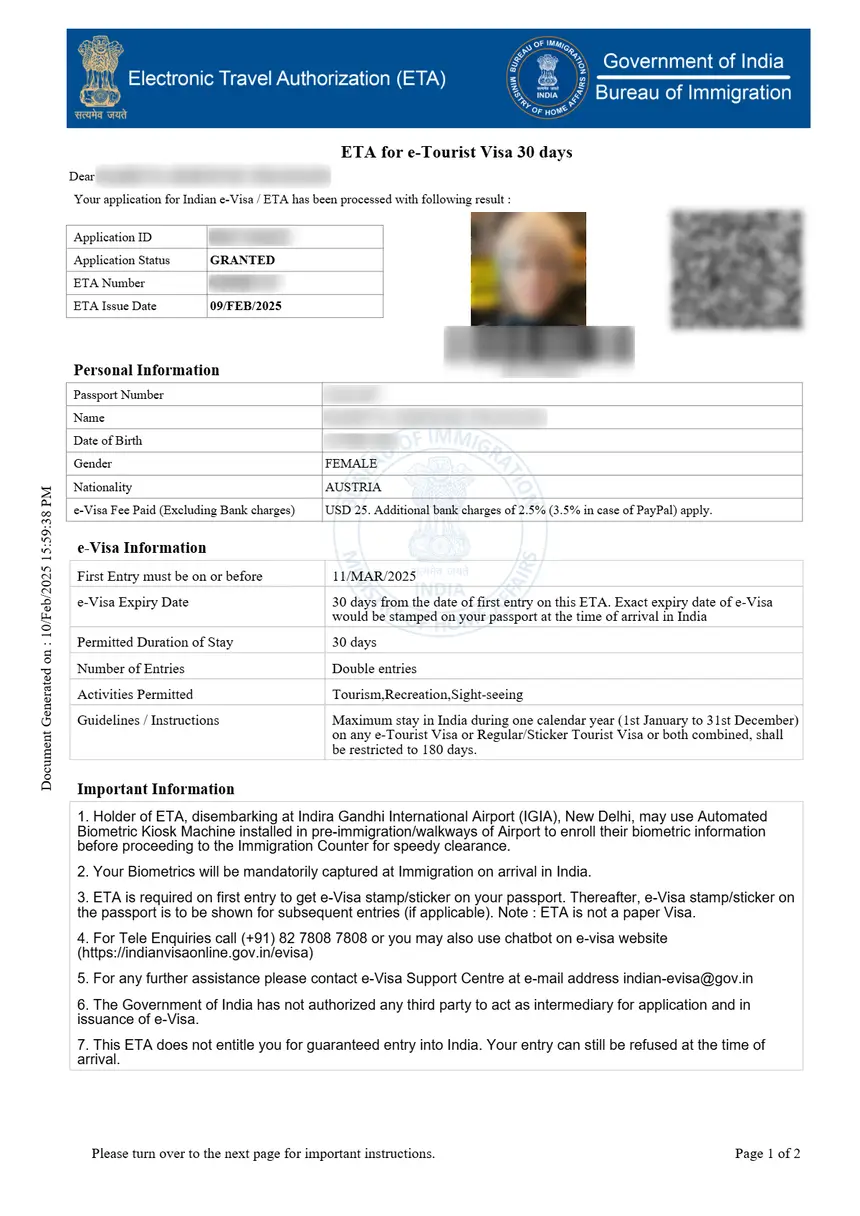
Unlike a regular medical visa that requires visiting an Indian embassy, the e-Medical Visa can be obtained online in a few simple steps. You receive your Electronic Travel Authorization (ETA) by email, which you print and present at immigration upon arrival.
The e-Medical Visa is officially classified as the e-M Visa in India’s visa category system. It is distinct from the e-Medical Attendant Visa (e-MA), which accompanies a patient traveling on an e-Medical Visa.
Who Should Apply for a Medical Visa?
You should apply for the e-Medical Visa if you are:
- Traveling to India specifically for medical treatment at a recognized hospital
- Seeking specialized procedures such as cardiac surgery, organ transplants, orthopedic care, cancer treatment, neurosurgery, or fertility treatments
- Visiting India for follow-up consultations or check-ups related to prior treatment
- Requiring treatment at an Ayurveda, yoga, or traditional medicine center
If you are accompanying a patient rather than receiving treatment yourself, you need the e-Medical Attendant Visa instead. Up to two attendants can apply for the e-MA Visa per patient.
India Medical Visa: Duration and Validity
The e-Medical Visa has specific terms that differ from other India visa types:
| Feature | Details |
|---|---|
| Validity | 60 days from the date of arrival in India |
| Number of entries | Triple entry (you can enter India up to 3 times within the 60-day period) |
| Maximum stay | 60 days total (not per entry) |
| Extension | Can be extended up to 6 months by the FRRO/FRO in India |
| Convertible | Can be converted to a regular Medical Visa at the FRRO if treatment requires a longer stay |
Important distinctions:
- The 60-day validity starts from your date of arrival, not the date your ETA is granted.
- Triple entry means you can leave and re-enter India during your 60-day window. This is useful if your treatment requires multiple visits or if you need to travel to a neighboring country between appointments.
- If your treatment extends beyond 60 days, you must register with the Foreigners Regional Registration Office (FRRO) to extend your stay. Hospitals typically assist international patients with this process.
- The e-Medical Visa cannot be used for employment, business activities, or tourism unrelated to medical treatment.
India Medical Visa Requirements
Before applying, gather all required documents. Incomplete applications are the most common reason for delays and rejections.
Passport Requirements
Your passport must meet these conditions:
- Valid for at least 6 months from the date of arrival in India
- At least 2 blank pages for immigration stamps
- Must be an ordinary passport (diplomatic or official passports follow a different process)
For more details, see our guide on India visa passport requirements.
Photo Requirements
You need a recent digital photograph that meets these specifications:
- Color photo with a white background
- Square format, minimum 350 x 350 pixels
- JPEG format, file size between 10 KB and 1 MB
- Face should occupy 60-80% of the frame
- Neutral expression, eyes open, no glasses or head coverings (unless for religious reasons)
Medical-Specific Documents
In addition to your passport and photo, you will need:
- Letter from the recognized Indian hospital confirming your appointment or admission for treatment. The hospital must be recognized by the Government of India.
- Medical records or referral letter from a doctor in your home country describing your condition and the need for treatment in India.
- Proof of sufficient funds to cover your medical treatment and stay in India. This can include bank statements, insurance coverage letters, or a sponsor letter.
- Return or onward ticket showing you plan to leave India after treatment.
Accepted Medical Institutions
The e-Medical Visa is valid only for treatment at hospitals recognized by the Indian government. Most major hospitals in India qualify, including:
- All India Institute of Medical Sciences (AIIMS)
- Apollo Hospitals
- Fortis Healthcare
- Max Healthcare
- Medanta – The Medicity
- Narayana Health
- Manipal Hospitals
- Kokilaben Dhirubhai Ambani Hospital
- Christian Medical College (CMC), Vellore
- Tata Memorial Hospital
If you are unsure whether your chosen hospital qualifies, contact the hospital’s international patient department. They typically have experience assisting with visa documentation.
How to Apply for an India Medical Visa Online
The application process for the e-Medical Visa is straightforward and entirely online. Follow these steps:
Step 1: Visit the Official Portal
Go to indianvisaonline.gov.in and click on “Regular Visa Application” or “e-Visa Application.” Select “e-Medical Visa” as your visa type.
Step 2: Fill Out the Application Form
You will need to provide:
- Personal details (full name, date of birth, nationality, gender)
- Passport information (number, issue date, expiry date)
- Contact details (email address, phone number)
- Travel details (expected date of arrival, port of entry)
- Medical information (name of hospital, type of treatment)
- Previous India visa history (if any)
Step 3: Upload Documents
Upload your:
- Passport bio-data page scan (PDF or JPEG, up to 300 KB)
- Recent passport-style photograph (JPEG, 10 KB – 1 MB)
- Letter from the Indian hospital (PDF or image)
Step 4: Pay the Visa Fee
Pay the fee online using a credit card or debit card. The fee depends on your nationality and is non-refundable. See the fee breakdown below.
Step 5: Receive Your ETA
After submission, most applications are processed within 72 hours. You will receive your ETA (Electronic Travel Authorization) by email. Print a copy to carry with your travel documents.
Step 6: Travel to India
Present your printed ETA and passport at the immigration counter upon arrival. Your biometrics may be recorded at the port of entry.
India Medical Visa Fees
The e-Medical Visa fee varies by nationality. Here is the general breakdown:
| Nationality | 60-Day Medical e-Visa Fee |
|---|---|
| United States | $25 |
| United Kingdom | $25 |
| Canada | $25 |
| Australia | $25 |
| Most EU countries | $25 |
| Japan | $25 |
| Other eligible countries | $10 – $80 |
Additional costs to budget for:
- Bank processing fee: 2.5% – 3% of the visa fee (charged by the payment gateway)
- Currency conversion fee: If paying in a currency other than USD
- FRRO extension fee: If you need to extend beyond 60 days (typically free but requires documentation)
For a complete overview of all India visa costs, see our India visa fees guide.
India Medical Attendant Visa (e-MA)
If a family member or caregiver is accompanying the patient, they need a separate e-Medical Attendant Visa (e-MA Visa).
Key rules:
- Up to 2 attendants can apply per patient
- The attendant’s visa validity matches the patient’s e-Medical Visa (60 days)
- The attendant must apply with the patient’s ETA reference number
- The e-MA Visa does not allow the attendant to work or receive medical treatment
- Attendants can apply through the same online portal as the patient
Documents required for the e-MA Visa:
- Passport valid for 6 months with 2 blank pages
- Recent passport-style photograph
- Patient’s ETA reference number
- Proof of relationship to the patient (marriage certificate, birth certificate, or family register)
Common Reasons for Medical Visa Rejection
Understanding why applications get rejected helps you avoid delays:
- Incomplete documentation: Missing hospital letter, medical records, or proof of funds
- Hospital not recognized: The treatment facility must be a government-recognized Indian hospital
- Passport validity: Passport expiring within 6 months of arrival date
- Unclear medical purpose: The application does not clearly state the type of treatment needed
- Previous visa violations: Overstaying a previous Indian visa or violating visa conditions
- Incorrect information: Mismatch between application details and passport information
If your application is rejected: You can reapply with corrected documents. There is no waiting period between applications, but you must pay the fee again.
Top Medical Tourism Destinations in India
India’s major cities have world-class hospitals that cater specifically to international patients:
| City | Known For | Top Hospitals |
|---|---|---|
| Chennai | Cardiac surgery, orthopedics | Apollo, Fortis Malar, MIOT |
| Mumbai | Cancer treatment, transplants | Kokilaben, Hinduja, Tata Memorial |
| Delhi / NCR | Multi-specialty, neurosurgery | AIIMS, Max, Medanta, Fortis |
| Bangalore | Fertility treatment, eye care | Narayana Health, Manipal |
| Hyderabad | Joint replacement, spine surgery | Yashoda, KIMS, Apollo |
| Kolkata | Liver transplants, urology | AMRI, Narayana Superspecialty |
Many of these hospitals have dedicated international patient departments with multilingual staff, airport pickup services, and assistance with visa documentation and FRRO registration.
Tips for Medical Tourists
- Start your visa application early. Apply at least 2-3 weeks before your planned travel date to allow time for processing and any potential delays.
- Get a detailed hospital letter. The letter should specify your diagnosis, the proposed treatment, and the expected duration of stay. This strengthens your visa application.
- Carry printed copies. While the ETA is electronic, always carry a printed copy along with your hospital appointment letter and medical records.
- Arrange airport pickup. Most major hospitals offer airport transfer services for international patients. Contact the hospital in advance.
- Consider travel insurance. While India offers affordable healthcare, complications can arise. Travel insurance with medical coverage provides an extra safety net.
- Register with your embassy. Let your country’s embassy or consulate in India know you are in the country for medical treatment. They can assist in emergencies.
- Plan for follow-up. If your treatment requires multiple visits, ensure your visa allows triple entry and plan your trips within the 60-day validity window.
FAQs About the India Medical Visa
Can I get a medical visa for India without a hospital letter?
No. A letter from a recognized Indian hospital is a mandatory requirement for the e-Medical Visa. The letter must confirm your appointment or admission for treatment.
How long does it take to get an Indian medical visa?
Most e-Medical Visa applications are processed within 72 hours (3 business days). However, some applications may take longer if additional verification is needed. Apply at least 2-3 weeks before your travel date to be safe.
Can I extend my medical visa while in India?
Yes. The e-Medical Visa can be extended up to 6 months through the Foreigners Regional Registration Office (FRRO) if your treatment requires a longer stay. Your hospital will typically help you with the extension paperwork.
Can my spouse accompany me on a medical visa?
Yes. Your spouse (or one other family member) can apply for an e-Medical Attendant Visa (e-MA). Up to 2 attendants are allowed per patient. The attendant must apply with your ETA reference number.
What is the difference between a medical visa and a medical attendant visa?
The e-Medical Visa (e-M) is for the patient receiving treatment. The e-Medical Attendant Visa (e-MA) is for up to 2 family members or caregivers accompanying the patient. The attendant cannot receive treatment or work on the e-MA Visa.
Is India medical visa free for any nationality?
No. All nationalities must pay the e-Medical Visa fee. However, the fee varies by nationality, ranging from $10 to $80 for the 60-day visa.
Can I use the e-Medical Visa for Ayurveda or yoga treatment?
Yes. The e-Medical Visa covers treatment at recognized Ayurveda, yoga, and traditional medicine centers in India, provided the institution is government-recognized.
What happens if I overstay my medical visa in India?
Overstaying an Indian visa is a serious offense. You may face fines, detention, deportation, and a ban on future entry to India. If your treatment requires a longer stay, apply for an extension at the FRRO before your visa expires.
Which Indian hospitals are recognized for the medical visa?
Most major hospitals in India are recognized, including AIIMS, Apollo, Fortis, Max Healthcare, Medanta, Narayana Health, and Manipal Hospitals. Contact your chosen hospital’s international patient department if you are unsure.
Can I apply for a medical visa at an Indian embassy instead of online?
Yes. If you prefer, you can apply for a regular Medical Visa (not e-Medical Visa) at the nearest Indian embassy or consulate. The regular medical visa may allow a longer validity period but requires an in-person visit and more documentation.