Only a handful of countries enjoy visa-free entry to India. Citizens of Nepal and Bhutan can enter India without a visa or even a passport and stay indefinitely. Maldivian nationals can visit India visa-free for up to 90 days. For everyone else, India requires a visa – though the e-Visa system makes the process straightforward for citizens of over 160 countries.
India’s visa policy is among the more restrictive in Asia. Unlike popular tourist destinations in Southeast Asia that offer visa-free access to dozens of nationalities, India limits visa-free entry to just three countries – and two of those are neighboring nations with special bilateral treaties dating back decades.
This guide explains exactly which countries have visa-free access to India, what the rules are for each, and what your options are if your country is not on the list.
India Visa-Free Countries: Complete List
As of 2026, only three countries have visa-free access to India for ordinary passport holders:
| Country | Visa Required | Maximum Stay | Passport Required | Special Conditions |
|---|---|---|---|---|
| Nepal | No | Unlimited | No (national ID accepted) | Cannot arrive from China, Hong Kong, Macau, or Pakistan |
| Bhutan | No | Unlimited | No (national ID accepted) | Cannot arrive from China, Hong Kong, Macau, or Pakistan |
| Maldives | No | 90 days | Yes | Valid passport required |
This is a remarkably short list. For comparison, countries like Thailand offer visa-free access to over 60 nationalities, and Indonesia recently expanded its visa-free list to over 90 countries.
Nepal: Unlimited Stay, No Visa Needed
Nepali citizens enjoy the most generous visa-free arrangement with India of any country. Under the 1950 Indo-Nepal Treaty of Peace and Friendship, nationals of Nepal can:
- Enter India without a visa
- Travel without a passport (a national ID card or Nepali citizenship certificate is sufficient)
- Live and work in India without any time limit
- Cross the open border at any point between the two countries
This arrangement reflects the deep historical, cultural, and economic ties between India and Nepal. The open border allows free movement of people and goods, and millions of Nepali citizens live and work in India.
Important restriction: Nepali nationals cannot use this visa-free entry if they are arriving from, or transiting through, mainland China, Hong Kong, Macau, or Pakistan. In those cases, they must obtain a visa from an Indian embassy or consulate before traveling.
Bhutan: Unlimited Stay, No Visa Needed
Bhutanese citizens have an equally generous arrangement with India, based on the 1949 Treaty of Friendship (updated in 2007). Bhutanese nationals can:
- Enter India without a visa
- Travel with a Bhutanese national ID card or passport
- Live and work in India without any time limit
- Cross the border freely between Bhutan and India
Like Nepal, Bhutan has a special relationship with India that goes beyond typical diplomatic ties. India is Bhutan’s largest trading partner and closest ally, and the open border policy reflects this.
Same restriction applies: Bhutanese nationals arriving from or transiting through China, Hong Kong, Macau, or Pakistan must obtain a visa before entering India.
Maldives: 90 Days Visa-Free
Since March 1979, citizens of the Maldives have been able to visit India without a visa for stays of up to 90 days. This is the only visa-free arrangement India has with a non-neighboring country for ordinary passport holders.
Key details for Maldivian nationals:
- Maximum stay: 90 days per visit
- Passport required: Yes, a valid Maldivian passport is mandatory
- Purpose of visit: Tourism, business, and transit are all permitted
- Extension: The 90-day stay cannot be extended; for longer stays, a visa is required
The Maldives-India visa-free arrangement reflects the close bilateral relationship between the two Indian Ocean nations. India is one of the Maldives’ closest partners, and a significant number of Maldivian citizens study and receive medical treatment in India.
Overseas Citizens of India (OCI): Visa-Free Entry
While not a country-based exemption, the Overseas Citizen of India (OCI) card provides visa-free entry to India for foreign nationals of Indian origin. OCI cardholders can:
- Enter India without a visa
- Live and work in India without any time limit
- Own property in India (except agricultural land)
- Study in India without restrictions
OCI status is available to foreign nationals who were Indian citizens on or after January 26, 1950, or who are children/grandchildren of such persons. Citizens of Bangladesh and Pakistan are not eligible for OCI status.
Persons of Indian Origin (PIO) cards issued before January 9, 2015, have been merged with the OCI scheme. Expired PIO cards (after January 9, 2015) are treated as valid for entry purposes per Timatic guidelines.
Countries With Visa on Arrival for India
India offers a very limited Visa on Arrival (VoA) program. As of 2026, only citizens of the following countries can obtain a visa on arrival at select Indian airports:
| Country | Maximum Stay | Available At |
|---|---|---|
| Japan | 60 days | Delhi, Mumbai, Chennai, Kolkata, Bengaluru, Hyderabad |
| South Korea | 60 days | Delhi, Mumbai, Chennai, Kolkata, Bengaluru, Hyderabad |
| UAE | 60 days | Delhi, Mumbai, Chennai, Kolkata, Bengaluru, Hyderabad (requires prior Indian visa history) |
The VoA is granted at the discretion of immigration officers and is not guaranteed. It is strongly recommended to apply for an e-Visa in advance rather than relying on arrival processing.
India e-Visa: The Best Option for Most Travelers
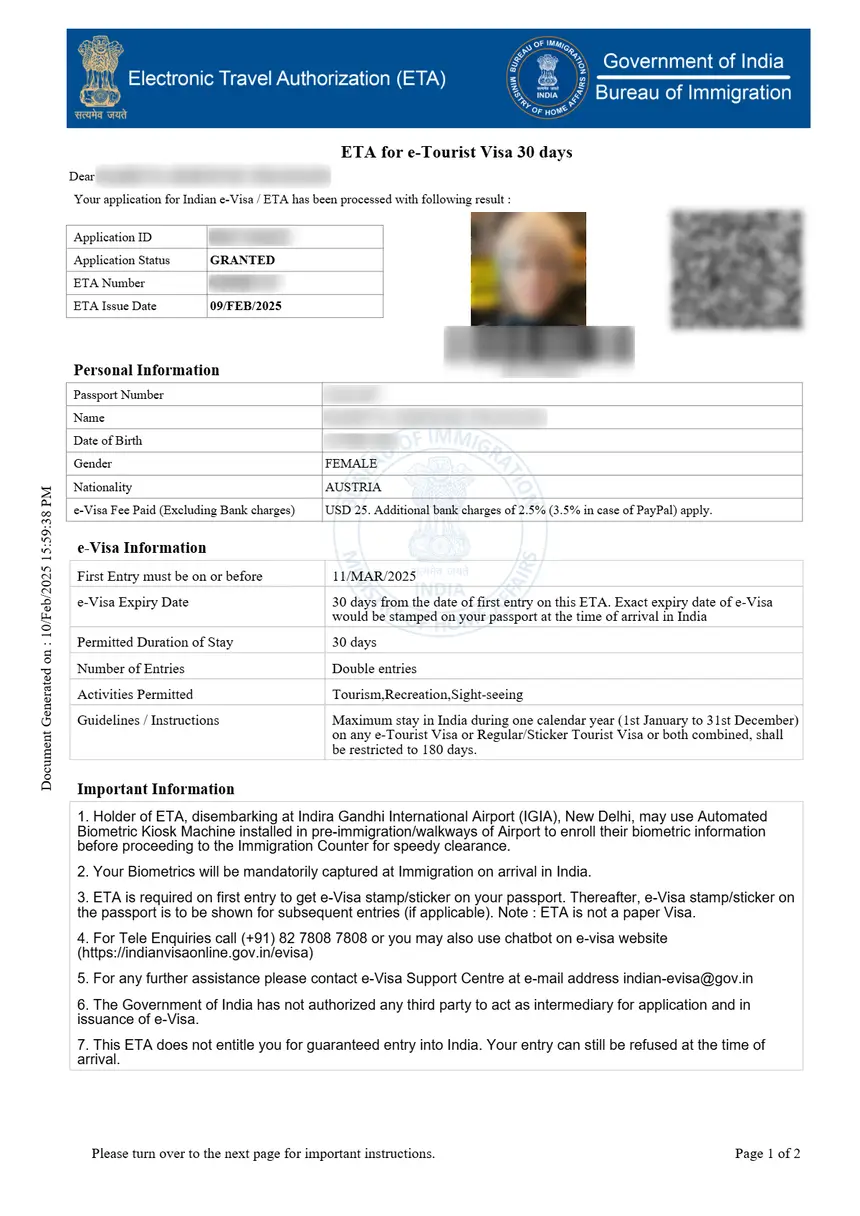
If your country is not on the visa-free or visa-on-arrival list, the India e-Visa is the fastest and most convenient way to get travel authorization. India’s e-Visa system covers citizens of 160+ countries and is available in several categories:
| e-Visa Type | Validity | Entries | Stay Per Entry |
|---|---|---|---|
| e-Tourist (30-day) | 30 days | Double | 30 days |
| e-Tourist (1-year) | 1 year | Multiple | 90 days (180 for US/UK) |
| e-Tourist (5-year) | 5 years | Multiple | 90 days (180 for US/UK) |
| e-Business | 1 year | Multiple | 180 days |
| e-Medical | 60 days | Triple | 60 days |
| e-Conference | 30 days | Single | 30 days |
| e-Attendant (Medical) | 60 days | Triple | 60 days |
| e-Transit | 15 days | Double | 15 days |
The e-Visa application is completed entirely online at indianvisaonline.gov.in – no embassy visit required. Processing takes approximately 72 hours. For a step-by-step walkthrough, see our guide on how to apply for India e-Visa online.
Countries NOT Eligible for India e-Visa
Citizens of the following countries must apply for a regular visa at an Indian embassy or consulate and cannot use the e-Visa system:
- Pakistan
- China (mainland)
- Hong Kong SAR (limited e-Visa categories)
- Macau SAR
- Bangladesh (limited categories)
- Nigeria (limited categories)
- Somalia
- Afghanistan (restricted access)
For these nationalities, the visa application process involves submitting documents in person at the nearest Indian diplomatic mission. Processing times vary from 5 business days to several weeks.
Why India Has So Few Visa-Free Countries
India’s restrictive visa policy contrasts sharply with many Asian countries that have liberalized entry requirements in recent years. Several factors explain this:
1. Security concerns: India shares borders with Pakistan and China, and faces ongoing security challenges that make open-border policies politically sensitive.
2. Immigration control: With a population of 1.4 billion, India prioritizes controlling inward migration rather than maximizing tourist arrivals through visa liberalization.
3. Bilateral reciprocity: India’s visa policy generally mirrors the treatment Indian citizens receive abroad. Since Indian passport holders face visa requirements in most countries, India applies similar restrictions.
4. Diplomatic exception: The only truly open borders India maintains are with Nepal and Bhutan, both driven by unique historical treaties and deep geopolitical relationships that predate modern visa systems.
Despite these restrictions, India has been gradually expanding its e-Visa program. The number of eligible countries has grown from around 40 when the program launched in 2014 to over 160 today, and new e-Visa categories have been added regularly.
India Visa-Free vs Neighboring Countries
How does India’s visa-free policy compare to its neighbors?
| Country | Visa-Free Countries | e-Visa Available |
|---|---|---|
| India | 3 | Yes (160+ countries) |
| Nepal | 0 (but easy VoA for most) | No |
| Sri Lanka | 0 (but ETA for most) | Yes (electronic travel authorization) |
| Thailand | 93 | Yes |
| Indonesia | 96 | Yes |
| Malaysia | 63 | Yes |
| Myanmar | 0 (but e-Visa for most) | Yes |
India’s visa-free list is the shortest in the region, but its e-Visa system is among the most accessible. For most travelers, the e-Visa effectively functions as a simplified visa process that eliminates the need to visit an embassy.
Frequently Asked Questions
Which countries can enter India without a visa?
Only three countries have visa-free access to India: Nepal (unlimited stay, no passport needed), Bhutan (unlimited stay, no passport needed), and Maldives (90-day stay with valid passport). All other nationalities require a visa.
Can US citizens travel to India without a visa?
No. US citizens need a visa to enter India. They are eligible for the e-Visa, which can be applied for online at indianvisaonline.gov.in. US citizens can get a 30-day, 1-year, or 5-year e-Tourist Visa. Processing takes about 72 hours. See our guide on [India e-Visa for US citizens](https://e-visa-india.info/do-americans-need-visa-india/) for details.
Can UK citizens travel to India without a visa?
No. UK citizens must obtain a visa before traveling to India. They are eligible for the e-Visa system and can apply online. The 1-year and 5-year e-Tourist Visas allow stays of up to 180 days per visit for UK citizens.
Do Nepali citizens need a passport to enter India?
No. Nepali citizens can enter India with just a national ID card or citizenship certificate – no passport is required. They can also live and work in India without any time limit. However, if arriving from or transiting through China, Hong Kong, Macau, or Pakistan, they need a valid visa.
How long can a Maldivian citizen stay in India without a visa?
Maldivian citizens can stay in India for up to 90 days without a visa, but they must carry a valid Maldivian passport. The 90-day period cannot be extended – for longer stays, they must apply for a visa.
Is the India e-Visa the same as visa-free entry?
No. The e-Visa still requires an online application, fee payment, and approval before travel. Visa-free entry means no application is needed at all – you simply arrive with your passport (or national ID for Nepal/Bhutan). The e-Visa is the closest most nationalities can get to a hassle-free entry.
Can I get a visa on arrival in India?
Visa on arrival in India is available only to citizens of Japan, South Korea, and UAE (with prior Indian visa history) at six major airports. For all other nationalities, you must obtain an e-Visa or regular visa before arriving. It is strongly recommended to apply for an e-Visa in advance.
Why does India have so few visa-free countries?
India’s limited visa-free list reflects security concerns along its borders, immigration control priorities, and a general policy of reciprocity with other nations. The country has gradually expanded its e-Visa program to cover 160+ countries instead of offering broad visa-free access.
Can Pakistani citizens visit India without a visa?
No. Pakistani citizens must apply for a regular visa at an Indian embassy or consulate. They are not eligible for the e-Visa system or visa on arrival. The application process involves additional scrutiny and typically takes longer than for other nationalities.
Do children from visa-free countries also get visa-free entry?
Yes. Children from Nepal, Bhutan, and the Maldives follow the same visa-free rules as adults. Nepali and Bhutanese children can enter with a national ID or birth certificate, while Maldivian children need a valid passport. All other nationalities, including children, require their own individual visa.