
India does not offer a standard visa on arrival to most foreign nationals. The e-Visa (electronic visa) is the primary entry option for tourists, business travelers, and medical visitors from over 160 eligible countries. If you are planning a trip to India, applying for an e-Visa online before departure is the only reliable way to secure your entry authorization.
Many travelers search for “visa on arrival India” hoping to get a stamp at the airport. While India did pilot a limited visa-on-arrival scheme for citizens of a handful of countries (Japan, South Korea, UAE, and a few others), the program is narrow and not available to most nationalities – including US, UK, Canadian, and Australian passport holders. The e-Visa system replaced the older visa-on-arrival model and is now the standard digital entry process.
What Is the India e-Visa?
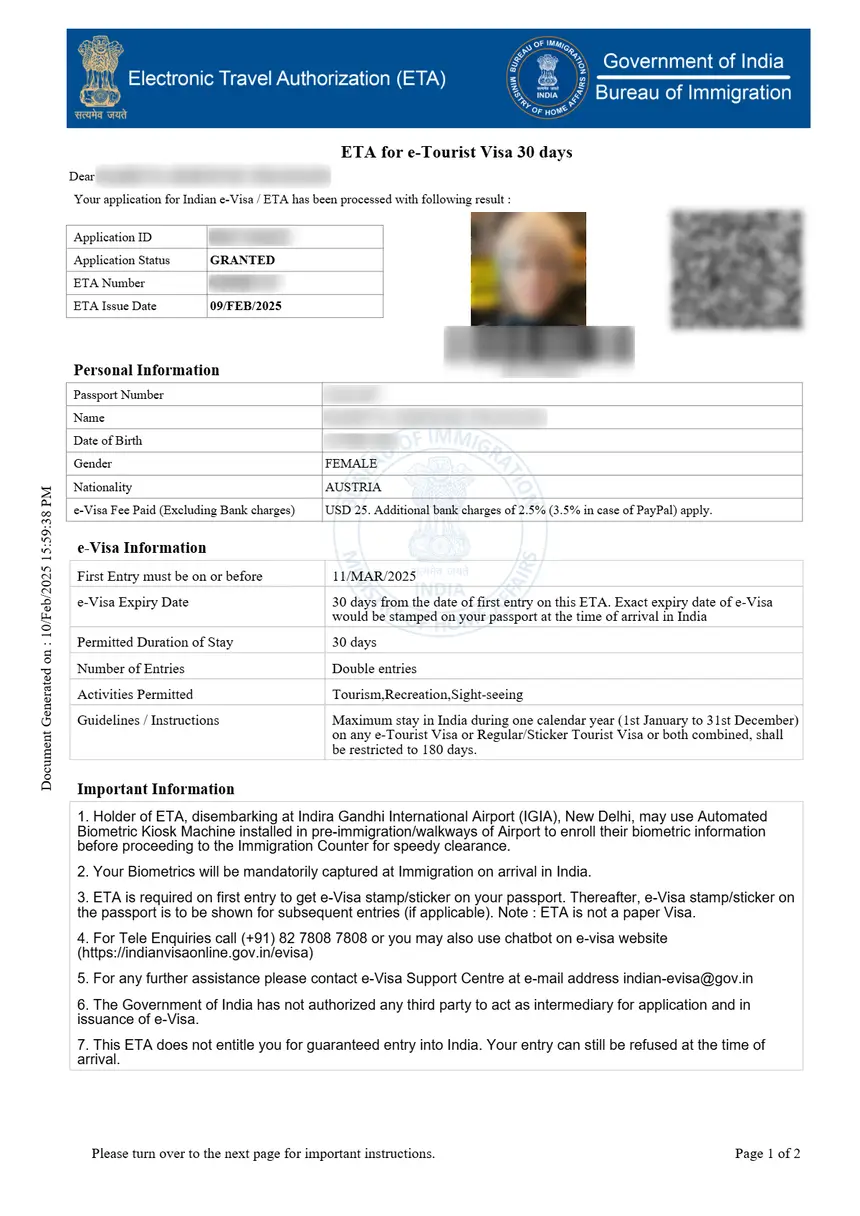
The India e-Visa is an electronic travel authorization issued by the Bureau of Immigration, Government of India. You apply entirely online – no embassy visit, no paper forms, no mailing your passport. Once approved, you receive an Electronic Travel Authorization (ETA) via email that you print and present at immigration upon arrival.
The e-Visa covers several categories:
| Category | Purpose | Typical Validity |
|---|---|---|
| e-Tourist | Sightseeing, visiting family, yoga retreats | 30 days, 1 year, or 5 years |
| e-Business | Business meetings, trade, conferences | 1 year |
| e-Medical | Medical treatment at recognized hospitals | 60 days (triple entry) |
| e-Medical Attendant | Accompanying a medical e-Visa holder | 60 days |
| e-Conference | Attending government-organized conferences | 30 days |
For a full breakdown of each type, see our guide to India visa types.
What Is Visa on Arrival for India?
Visa on arrival (VoA) means you obtain your visa after landing at the destination airport, without prior online application. Several Asian countries – Thailand, Indonesia, Cambodia – offer this option widely.
India’s situation is different. The Government of India does not provide a general visa-on-arrival facility for most nationalities. Here is what actually exists:
- Visa on Arrival for Japan and South Korea citizens – A limited VoA scheme at select airports (Delhi, Mumbai, Chennai, Kolkata, Bengaluru, Hyderabad) for short-term tourist visits. This covers only a very small number of nationalities.
- UAE nationals – Citizens of the UAE who have previously obtained an Indian visa may be eligible for VoA under specific bilateral arrangements.
- No VoA for US, UK, Canada, Australia, EU, or most other passports – If you hold one of these passports, you cannot get a visa at the airport. You must apply for an e-Visa (or a regular sticker visa from an embassy) before traveling.
e-Visa vs Visa on Arrival India: Side-by-Side Comparison
| Feature | India e-Visa | India Visa on Arrival |
|---|---|---|
| Eligible nationalities | 160+ countries | ~5 countries (Japan, South Korea, UAE, + few others) |
| Application method | Online (indianvisaonline.gov.in) | At the airport immigration counter |
| Apply before travel? | Yes – at least 4 days in advance | No – obtained upon landing |
| Processing time | 72 hours typical (up to 5 business days) | Immediate at airport (but limited eligibility) |
| Validity options | 30 days, 1 year, 5 years | 30 days (single/double entry) |
| Cost (tourist) | $10-$80 depending on duration | Free or nominal fee |
| Entry points | 28 designated airports + 5 seaports | Only select major airports |
| Passport validity required | 6 months from arrival + 2 blank pages | 6 months from arrival |
| Photo requirement | Digital upload during application | Taken at airport |
| Multiple entries? | Yes (1-year and 5-year allow multiple) | Limited (single or double) |
Why the e-Visa Is the Better Option for Most Travelers
For the vast majority of visitors, the India e-Visa is not just the better option – it is the only option. Here is why it works well:
1. Apply from anywhere. You fill out the application at indianvisaonline.gov.in, upload your passport photo and passport scan, pay by card, and receive your ETA by email. No embassy appointment needed.
2. Predictable timeline. Processing takes about 72 hours in most cases. You know your status before you fly, removing airport uncertainty.
3. Multiple validity choices. The 30-day e-Tourist visa suits short vacations. Frequent travelers can opt for the 1-year or 5-year multiple-entry visa, which eliminates repeat applications.
4. Accepted at all major entry points. The e-Visa works at 28 Indian airports (Delhi, Mumbai, Goa, Jaipur, Kochi, and more) and 5 seaports (Mumbai, Goa, Mangalore, Cochin, Chennai).
For step-by-step application instructions, see our guide on how to apply for India e-Visa online.
How to Apply for India e-Visa (Quick Steps)
- Visit indianvisaonline.gov.in and select “Apply here for e-Visa.”
- Fill in your personal details, passport information, and travel dates.
- Upload a recent passport-style photo (white background, JPEG, 10 KB-1 MB) and a passport bio page scan (PDF, up to 300 KB).
- Pay the fee online (Visa, MasterCard, PayPal, or other accepted methods).
- Wait for the ETA email (usually within 72 hours).
- Print the ETA and carry it with your passport to the airport.
For a detailed walkthrough with screenshots, read our complete e-Visa application guide.
India e-Visa Fees: What to Expect
Fees vary by nationality and visa duration:
| Visa Type | Duration | Fee (USD) |
|---|---|---|
| e-Tourist (short) | 30 days (April-June) | $10 |
| e-Tourist (short) | 30 days (July-March) | $25 |
| e-Tourist | 1 year | $40 |
| e-Tourist | 5 years | $80 |
| e-Business | 1 year | $80 |
| e-Medical | 60 days | $25 |
A bank processing fee of 2.5% is added on top. For the latest fee schedule, visit our India visa fees guide.
Common Misconceptions
“I can just get a visa at the airport in India.”
Not true for most nationalities. The e-Visa must be obtained before departure. Arriving without one means you will be denied boarding by your airline or turned away at Indian immigration.
“Visa on arrival is cheaper than e-Visa.”
India’s e-Visa fees start at just $10 for the 30-day option during the off-season (April-June). This is among the lowest visa fees in the world. The cost difference, even if VoA were available, would be negligible.
“The e-Visa process is complicated.”
The application takes about 15-20 minutes. Most applicants receive approval within 72 hours. The main reasons for rejection are incomplete forms, poor-quality photos, or passport validity under 6 months.
When You Might Need a Regular (Sticker) Visa Instead
The e-Visa has some limitations. You need a traditional sticker visa from an Indian embassy or consulate if:
- Your nationality is not on the e-Visa eligibility list
- You plan to stay longer than the maximum e-Visa duration
- You need a work visa, student visa, or research visa
- You are entering India overland (e-Visa is valid only at designated airports and seaports)
- You have a diplomatic or official passport requiring a special visa category
For an overview of all visa categories, see our India visa types guide.
FAQs About e-Visa vs Visa on Arrival India
Does India offer visa on arrival for US citizens?
No. US citizens cannot get a visa on arrival in India. You must apply for an e-Visa online before your trip at indianvisaonline.gov.in. The e-Visa is available in 30-day, 1-year, and 5-year options for US passport holders.
Which countries can get visa on arrival in India?
India offers a limited visa-on-arrival facility to citizens of Japan, South Korea, and (under specific conditions) the UAE. This is available only at select major airports. Most other nationalities, including US, UK, Canadian, and EU citizens, must apply for an e-Visa.
Is the India e-Visa the same as visa on arrival?
No. The e-Visa is applied for and approved online before you travel. Visa on arrival is obtained at the airport after landing. India’s e-Visa requires advance application – you cannot get it at the airport. The two systems are fundamentally different in process and eligibility.
How long does India e-Visa processing take?
Most e-Visa applications are processed within 72 hours. Some are approved within 24 hours. The Government of India recommends applying at least 4 days before your travel date. Applying 2-4 weeks in advance is advisable to allow time for corrections if needed.
Can I enter India without a visa?
Only citizens of Nepal and Bhutan can enter India without a visa (with a valid passport or national ID). All other foreign nationals need either an e-Visa, a regular sticker visa, or (for the few eligible nationalities) a limited visa on arrival.
What happens if I arrive in India without a visa?
You will be denied entry. Airlines typically check for a valid visa before allowing you to board. If you somehow reach Indian immigration without a visa, you will be placed on the next available flight back to your point of origin at your own expense.
Is the India e-Visa free?
No, but it is inexpensive. The cheapest option is the 30-day e-Tourist visa at $10 during the April-June period. The rest of the year it costs $25. The 1-year and 5-year options cost $40 and $80 respectively.
Can I convert a tourist visa to a work visa while in India?
No. The e-Visa cannot be converted to a different visa category while you are in India. If you need a work visa, student visa, or research visa, you must apply at an Indian embassy or consulate before traveling.