
Yes, British citizens need a visa to enter India – there is no visa-free entry for UK passport holders. The India e-Visa is the fastest and most convenient option, allowing you to apply entirely online without visiting the Indian High Commission or a visa application centre. This guide covers everything UK travellers need to know about getting an Indian e-Visa, from eligibility and fees to step-by-step application instructions.
Do UK Citizens Need a Visa for India?
British citizens cannot enter India without a valid visa. Unlike some Commonwealth countries that historically had easier access, India requires all UK travellers to obtain a visa before arrival. The e-Visa system makes this process straightforward – you can complete the entire application from home in about 15 to 20 minutes.
There are two main paths for UK citizens:
- e-Visa (electronic visa): Apply online, receive approval by email, and present the printed ETA at immigration. Best for tourism, short business trips, medical visits, and conferences.
- Regular (sticker) visa: Apply through the Indian High Commission in London, the Consulate General in Birmingham or Edinburgh, or a VFS Global centre. Required for stays longer than the e-Visa allows, employment, student visas, or other specialised categories.
For most British travellers visiting India for tourism or short business purposes, the e-Visa is the recommended route. It eliminates the need to mail your passport or attend an in-person appointment.
Types of India e-Visa Available to UK Citizens
British citizens are eligible for all four sub-categories of the India e-Visa. Each serves a different purpose and comes with its own validity period and entry allowances.
| e-Visa Type | Validity | Entries | Purpose |
|---|---|---|---|
| e-Tourist (30-day) | 30 days from arrival | Double entry | Sightseeing, visiting friends/family, yoga retreats |
| e-Tourist (1-year) | 1 year from grant | Multiple entry | Repeat tourism visits |
| e-Tourist (5-year) | 5 years from grant | Multiple entry | Frequent travellers to India |
| e-Business | 1 year from grant | Multiple entry | Business meetings, trade, conferences |
| e-Medical | 60 days from arrival | Triple entry | Medical treatment at Indian hospitals |
| e-Conference | 30 days from arrival | Single entry | Government-organised conferences |
The 30-day e-Tourist visa is the most popular choice for first-time visitors from the UK. If you plan to visit India multiple times within a year, the 1-year or 5-year options offer better value since you avoid reapplying for each trip.
For detailed information about each tourist visa tier, see our India Tourist e-Visa guide.
India e-Visa Requirements for UK Citizens
Before starting your application, make sure you have the following documents and items ready:
Passport Requirements:
– Valid British passport with at least 6 months of remaining validity from your date of arrival in India
– At least 2 blank pages in your passport for entry and exit stamps
– The passport must be an ordinary passport (not diplomatic or official)
Digital Photo:
– Recent colour photograph taken within the last 6 months
– White background, front-facing, with a neutral expression
– JPEG format, file size between 10 KB and 1 MB
– Dimensions: 2 inches x 2 inches (51 mm x 51 mm)
– No glasses, hats, or head coverings (except for religious reasons)
Passport Scan:
– Clear scan of the photo page of your passport
– PDF format, file size between 10 KB and 300 KB
Additional Requirements:
– Valid email address (your e-Visa ETA will be sent here)
– Credit or debit card for fee payment (Visa, Mastercard, or American Express accepted)
– Return flight ticket or onward travel proof (may be requested)
– Sufficient funds for your stay (rarely checked but recommended)
For the full checklist of document specifications, visit our India visa requirements page.
How to Apply for India e-Visa from the UK (Step by Step)
The application process is entirely online through the official Indian government portal. Follow these steps carefully to avoid delays or rejections.
Step 1: Visit the Official Website
Go to indianvisaonline.gov.in and click “Apply here for e-Visa.” Be cautious of third-party websites that charge extra fees – the official site is the only legitimate portal.
Step 2: Fill Out the Application Form
Enter your personal details exactly as they appear on your passport. This includes:
– Full name, date of birth, nationality (select “United Kingdom” or “UK”)
– Passport number, issue date, expiry date
– Port of expected arrival in India
– Purpose of visit and e-Visa sub-type
– Employment details and educational background
– Previous India travel history (if any)
– Reference contact in India (hotel name and address work fine)
Step 3: Upload Documents
Upload your passport photo (JPEG) and passport scan (PDF) according to the size requirements listed above. The system validates file formats and sizes automatically.
Step 4: Pay the Fee
Use a credit or debit card to pay the e-Visa fee. A bank processing fee of 2.5% applies on top of the base fee. You will receive a confirmation with an application ID – save this number.
Step 5: Wait for Processing
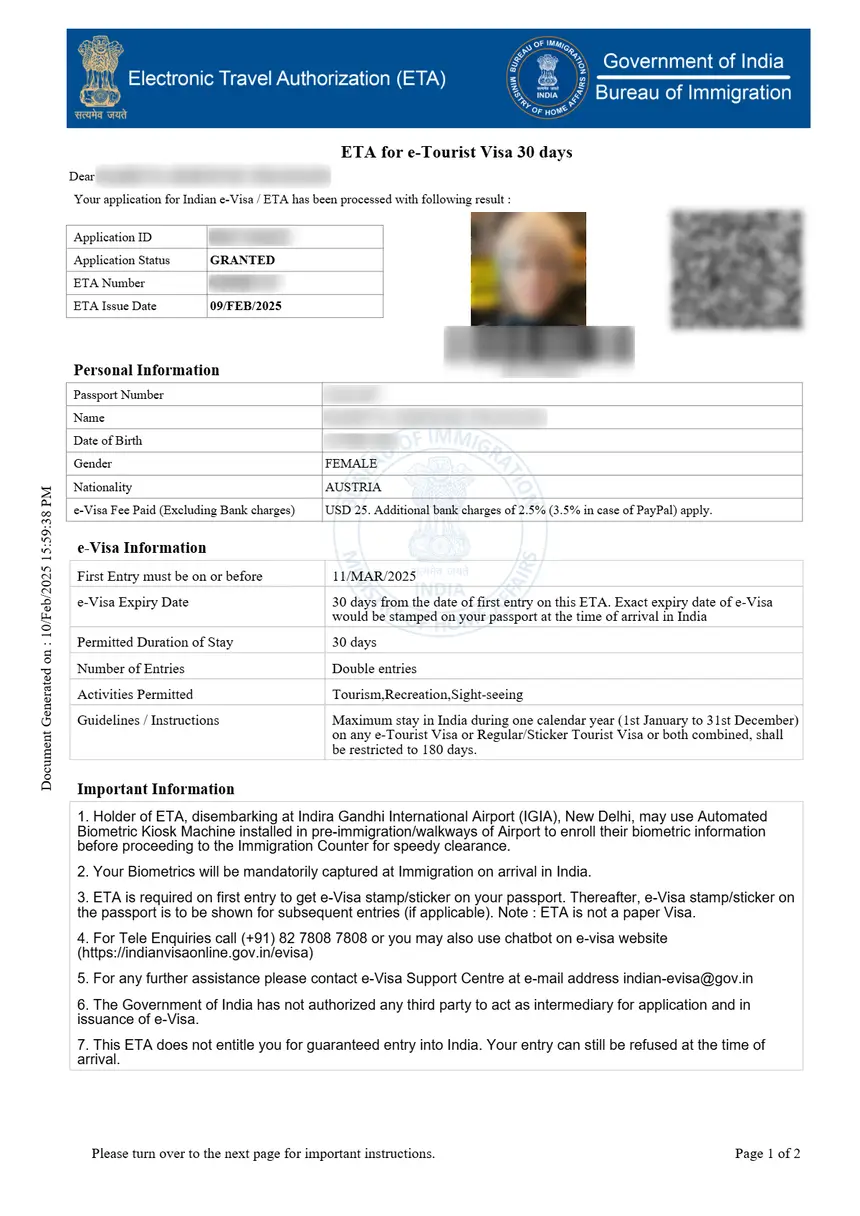
Standard processing takes about 72 hours, though it can take up to 5 business days during peak travel seasons. You will receive an email with your Electronic Travel Authorization (ETA) once approved.
Step 6: Print Your ETA
Download and print the ETA document. While you can show it on your phone at immigration, carrying a printed copy is strongly recommended as a backup.
For a more detailed walkthrough with screenshots, see our step-by-step application guide.
India e-Visa Fees for UK Citizens
The e-Visa fee depends on the type and duration you select. All fees are quoted in US dollars (the official portal does not accept GBP) and are non-refundable, even if your application is denied.
| e-Visa Type | Base Fee (USD) | With Bank Fee (2.5%) | Approximate GBP |
|---|---|---|---|
| 30-day e-Tourist | $10-$25 | $10.25-$25.63 | £8-£20 |
| 1-year e-Tourist | $40 | $41.00 | £32 |
| 5-year e-Tourist | $80 | $82.00 | £65 |
| e-Business | $80 | $82.00 | £65 |
| e-Medical | $80 | $82.00 | £65 |
| e-Conference | $80 | $82.00 | £65 |
Note: The 30-day e-Tourist fee varies seasonally. During peak season (July to March), the fee is typically $25. During the off-season (April to June), it drops to $10. The Indian government periodically adjusts these rates. GBP equivalents are approximate and depend on the current exchange rate.
The 2.5% bank processing fee is charged by the payment gateway and is not part of the visa fee itself. There are no additional service charges on the official indianvisaonline.gov.in site.
For a complete breakdown of all visa categories including regular (non-e-Visa) options, see our India visa fees guide.
India e-Visa Processing Time from the UK
Processing times for UK applicants are generally consistent, though they can vary based on application volume and the time of year.
| Processing Scenario | Typical Duration |
|---|---|
| Standard processing | 72 hours (3 business days) |
| Peak season (Oct-Mar) | 3-5 business days |
| Off-season (Apr-Sep) | 24-72 hours |
| Rush / urgent cases | Not officially available |
There is no expedited or premium processing option for the India e-Visa. All applications go through the same queue. If you need your visa faster, the only alternative is applying for a regular visa through the Indian High Commission in London, which may offer faster turnaround in some cases.
Pro tip: Apply at least 2 weeks before your travel date. While most approvals arrive within 72 hours, occasional delays happen due to high application volumes, incomplete documentation, or random security screenings. Applying early gives you a buffer to correct any issues without disrupting your travel plans.
Entry Points and Validity for UK e-Visa Holders
The India e-Visa is accepted at 28 designated international airports and 5 seaports. You cannot enter India through land border crossings with an e-Visa.
Designated Airports:
Ahmedabad, Amritsar, Bagdogra, Bengaluru, Bhubaneswar, Calicut, Chennai, Chandigarh, Cochin, Coimbatore, Delhi, Gaya, Goa (Dabolim and Mopa), Guwahati, Hyderabad, Jaipur, Kannur, Kolkata, Lucknow, Madurai, Mangalore, Mumbai, Nagpur, Port Blair, Pune, Tiruchirapalli, Trivandrum, Varanasi, and Visakhapatnam.
Designated Seaports:
Chennai, Cochin, Goa (Mormugao), Mangalore, and Mumbai.
If you are arriving by cruise ship or through a smaller regional airport not on this list, you will need a regular sticker visa instead of an e-Visa.
Validity rules to keep in mind:
– The 30-day e-Visa validity starts from the date of arrival in India, not the date of approval
– The 1-year and 5-year e-Visas start from the date the visa is granted
– You must enter India before the e-Visa expires, but you can stay beyond the validity if your visa allows multiple entries
– Each continuous stay on a 30-day visa cannot exceed 30 days
– For 1-year and 5-year tourist visas, each stay cannot exceed 90 days per visit (180 days for business)
Common Reasons e-Visa Applications Get Rejected
Understanding why applications fail can help you avoid common pitfalls. The most frequent reasons for e-Visa rejection among UK applicants include:
- Passport validity issues: Your passport expires within 6 months of your arrival date in India. Always check your passport expiry before applying.
- Photo not meeting specifications: Blurry photos, wrong background colour, wearing glasses, or incorrect file size. Follow the photo guidelines precisely.
- Incorrect passport information: Typos in your passport number, name spelling, or date of birth. Double-check every field before submitting.
- Previous visa overstay: If you have overstayed a previous Indian visa, your e-Visa application may be denied. You may need to apply for a regular visa and explain the overstay.
- Incomplete application: Leaving required fields blank or providing vague information about your travel purpose or Indian reference contact.
- Previously held Pakistani origin: Applicants of Pakistani origin or those who have held Pakistani passports face additional scrutiny and may need to apply through the embassy route.
If your e-Visa is rejected, you can reapply. However, the fee is non-refundable, so you will need to pay again. Consider applying for a regular visa through the High Commission if your e-Visa is rejected twice.
Tips for a Smooth India e-Visa Application from the UK
Based on common issues reported by UK travellers, here are practical tips to ensure your application goes through without problems:
- Apply early: Submit your application at least 14 days before departure. Avoid last-minute applications, especially during the October to March peak season.
- Use the official site only: Apply at indianvisaonline.gov.in. Third-party sites charge £40-£120 in extra “service fees” for the same visa.
- Match your passport exactly: Enter your name, passport number, and dates exactly as printed on your passport. Even a single-digit error can cause rejection.
- Save your application ID: Write down or screenshot your Application ID immediately after submission. You need it to check status and retrieve your ETA.
- Check your email spam folder: The ETA approval email sometimes lands in spam or promotions folders. Search for emails from “indianvisaonline” if you do not see the approval in your inbox.
- Print a backup copy: While digital copies work at most airports, a printed ETA avoids any issues if your phone battery dies or the airport Wi-Fi is unavailable.
- Keep supporting documents handy: Immigration officers rarely ask for them, but having your return flight booking and hotel reservation printed can speed up the entry process.
FAQs About India e-Visa from UK
Do British citizens need an e-Visa for India?
Yes, all UK citizens need a valid visa to enter India. The e-Visa is the most convenient option for tourism, business, medical, and conference visits. There is no visa-free entry for British passport holders.
How long does it take to get an Indian e-Visa from the UK?
Standard processing takes about 72 hours (3 business days). During peak season from October to March, it may take up to 5 business days. There is no expedited processing option.
Can UK citizens get a 10-year visa for India?
The e-Visa system offers a maximum validity of 5 years. For a 10-year tourist visa, British citizens must apply through the Indian High Commission in London or a VFS Global centre with their passport and supporting documents.
How much does the India e-Visa cost for UK citizens?
The 30-day e-Tourist visa costs $10 to $25 (approximately £8-£20) depending on the season. The 1-year tourist visa is $40 (around £32), and the 5-year visa is $80 (around £65). A 2.5% bank processing fee applies to all payments.
What is the official website to apply for India e-Visa?
The only official portal is indianvisaonline.gov.in. Avoid third-party websites that charge extra service fees. The Indian government does not authorise any other website for e-Visa applications.
Can I extend my e-Visa while in India?
No, the India e-Visa cannot be extended or converted to another visa type while in India. If you need a longer stay, you must leave India and apply for a new visa. The only exception is in cases of medical emergencies, which are handled on a case-by-case basis by the Foreigners Regional Registration Office (FRRO).
Do I need to show a return flight when applying for the e-Visa?
While the application does not always require uploading a return flight booking, immigration officers at the airport may ask to see proof of onward travel. It is recommended to have a return or onward flight ticket available.
Can I work in India with an e-Visa?
No, the e-Visa does not authorise employment in India. For work purposes, you need an Employment Visa, which must be obtained through the Indian High Commission. The e-Business visa allows business meetings and trade activities but not paid employment.
What happens if my e-Visa application is rejected?
If your e-Visa is rejected, you can reapply through the same portal. The fee is non-refundable, so you will need to pay again. If your application is rejected multiple times, consider applying for a regular visa through the Indian High Commission, where you can address any concerns directly.
Is travel insurance required for the India e-Visa?
Travel insurance is not a requirement for the India e-Visa application. However, it is strongly recommended given the cost of medical care in India and potential flight disruptions. Many UK travel insurance policies include India cover, but always check your policy details before departure.