
The India Tourist e-Visa comes in three validity options – 30 days, 1 year, and 5 years – each designed for different travel patterns, from a single holiday to frequent visits over several years. Citizens of over 170 countries can apply entirely online through the official indianvisaonline.gov.in portal, with approvals typically issued within 72 hours.
Choosing the right e-Tourist Visa option depends on how long you plan to stay, how often you intend to visit India, and whether you need the flexibility of multiple entries. This guide breaks down each option, compares fees, explains the application process, and answers the most common questions travelers have.
India Tourist e-Visa: 30-Day vs 1-Year vs 5-Year
The Indian government offers three distinct e-Tourist Visa sub-types under the e-Visa system. Each has different validity periods, entry allowances, and fees. Here is how they compare:
| Feature | 30-Day e-Tourist Visa | 1-Year e-Tourist Visa | 5-Year e-Tourist Visa |
|---|---|---|---|
| Validity | 30 days from date of arrival | 365 days from date of ETA grant | 5 years from date of ETA grant |
| Entries | Double entry | Multiple entry | Multiple entry |
| Max stay per visit | 30 days | 180 days per calendar year | 180 days per calendar year |
| Extendable | No | No | No |
| Convertible | No | No | No |
| Fee (most nationalities) | $25 | $40 | $80 |
| Bank processing fee | 2.5% extra | 2.5% extra | 2.5% extra |
| Best for | Single short trip | Multiple trips within one year | Frequent visitors over several years |
The 30-day option is the most affordable and works well for a single vacation. The 1-year visa suits travelers who plan to visit India more than once within twelve months. The 5-year visa is ideal for frequent travelers, business visitors with tourism interests, or anyone with family ties in India who visits regularly.
30-Day e-Tourist Visa in Detail
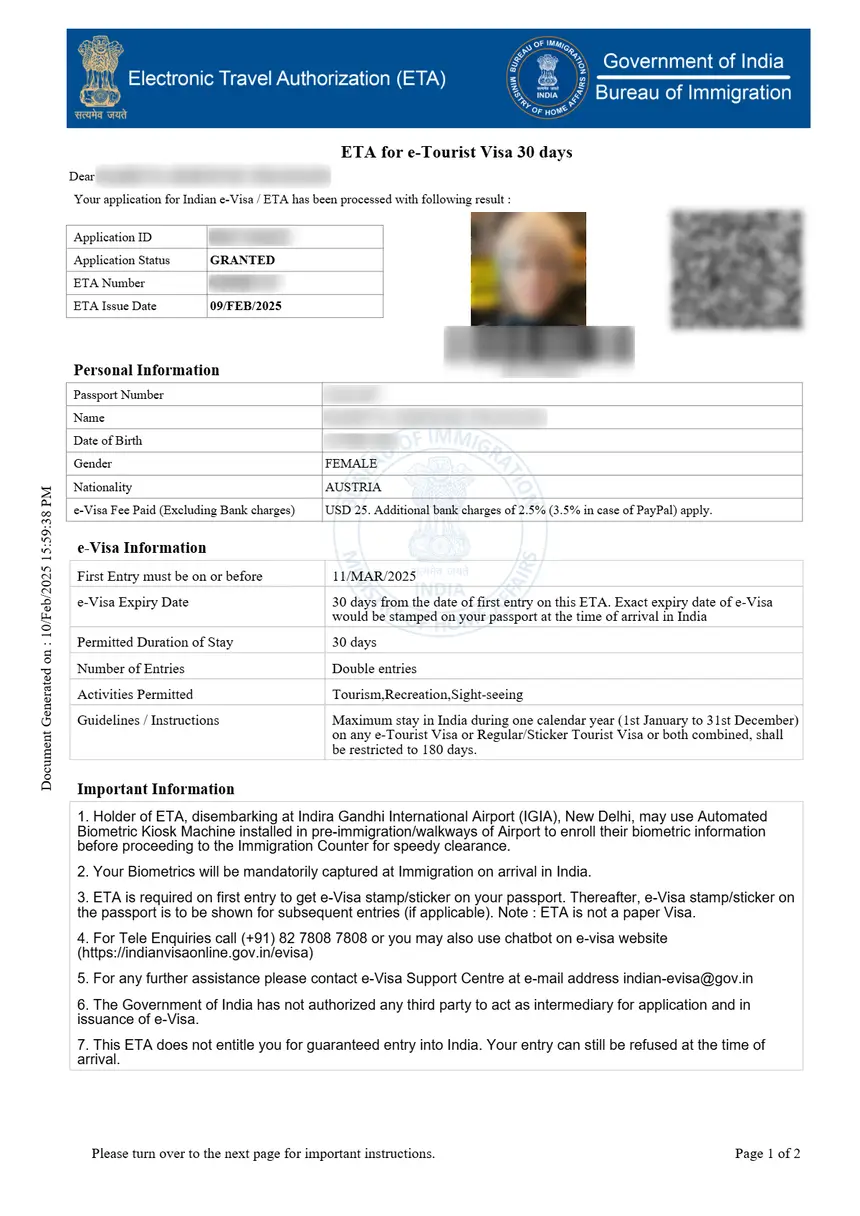
The 30-day e-Tourist Visa is the entry-level option and the most commonly issued. It allows double entry, meaning you can leave India and re-enter once during the validity period. This is useful if you plan a side trip to Nepal, Sri Lanka, or Bhutan during your India visit.
Key points about the 30-day visa:
- Validity starts from the date of arrival in India, not from the date of approval
- Cannot be extended or converted to another visa type while in India
- Must be used within 120 days of issuance (the ETA has a window of validity)
- The $25 fee applies to most nationalities; some countries have different rates
- A 2.5% bank processing fee is added on top of the visa fee at the time of payment
The 30-day option is the simplest and cheapest for travelers who are making a single trip and do not plan to leave and re-enter India multiple times. For a detailed look at all visa categories, see our India Visa Types guide.
1-Year e-Tourist Visa in Detail
The 1-year e-Tourist Visa provides 365 days of validity from the date the Electronic Travel Authorization (ETA) is granted. Unlike the 30-day visa, this option allows multiple entries, so you can come and go from India as many times as needed within the year.
Important details:
- Multiple entry means no limit on the number of entries during the validity period
- Maximum stay in India during any single calendar year is 180 days
- The 180-day limit applies to the calendar year (January to December), not a rolling 12-month period
- If you enter India in November on a 1-year visa, your 180-day allowance resets on January 1
- The $40 fee is a flat rate for most nationalities
- Cannot be extended beyond the 1-year validity
This option works well for travelers who plan to visit India two or three times in a year, or who want the flexibility of an extended stay without committing to the 5-year option.
5-Year e-Tourist Visa in Detail
The 5-year e-Tourist Visa is the longest-validity tourist option available through the e-Visa system. It grants multiple entries over five years from the date of ETA issuance.
Key facts:
- Multiple entries throughout the 5-year period
- The same 180-day-per-calendar-year stay limit applies
- Costs $80 for most nationalities – significantly cheaper per year than repeated 1-year applications
- Cannot be extended; you must apply for a new e-Visa after the 5 years expire
- Passport must remain valid for the entire duration; if your passport expires, the visa becomes invalid
The 5-year visa is the best value for frequent travelers. Even if you visit India only twice in five years, the cost per trip is comparable to the 1-year visa. For travelers who visit annually, the savings over five separate 1-year applications are substantial. For a complete breakdown of all visa fees, see our India Visa Fees guide.
How to Apply for an India Tourist e-Visa
The application process is the same regardless of which e-Tourist Visa option you choose. Everything is done online through the official government portal at indianvisaonline.gov.in.
Step-by-Step Application Process
- Visit indianvisaonline.gov.in and click “Apply here for e-visa”
- Fill in the application form with your personal details, passport information, and travel plans
- Upload a recent passport-size photograph (white background, JPEG format, 10KB-1MB)
- Upload a clear scan of your passport’s bio page (PDF format, 10KB-300KB)
- Pay the visa fee online using a credit card, debit card, or payment wallet
- Receive your Electronic Travel Authorization (ETA) by email, typically within 72 hours
- Print the ETA and carry it with you when you travel
- Present the printed ETA at the immigration check post in India, where the e-Visa will be stamped in your passport
The government of India does not charge any emergency or express processing fees. All applications are processed in the standard queue. If any document or image is not appropriate, you will be notified by email and asked to re-upload.
Documents Required
To apply for any India Tourist e-Visa, you need:
- A passport valid for at least 6 months from the date of arrival in India
- At least 2 blank pages in your passport for the visa stamp
- A recent passport-size color photograph with a white background
- A return or onward flight ticket
- Proof of sufficient funds for your stay (not always requested but recommended)
- A valid email address to receive the ETA
For a detailed checklist of all requirements, see our India Visa Requirements guide.
Who Is Eligible for the India Tourist e-Visa?
Citizens of over 170 countries and territories are eligible for the India e-Visa, including the United States, United Kingdom, Canada, Australia, Germany, France, Japan, South Korea, Brazil, and most of Europe and Latin America.
Notable exceptions – travelers who are NOT eligible for the e-Visa include citizens of Pakistan, who must apply through the traditional embassy route. Citizens of some countries may have different fee structures or additional requirements.
The e-Visa is available at 29 designated airports and 5 designated seaports in India. Land border crossings do not accept e-Visa holders. The designated airports include Delhi, Mumbai, Chennai, Kolkata, Bangalore, Hyderabad, Goa, Jaipur, Kochi, Ahmedabad, Amritsar, Bagdogra, Bhubaneswar, Calicut, Chandigarh, Coimbatore, Gaya, Guwahati, Kannur, Lucknow, Madurai, Mangalore, Nagpur, Port Blair, Pune, Tiruchirapalli, Trivandrum, Varanasi, and Visakhapatnam.
Important Rules and Restrictions
Before applying, be aware of these key restrictions:
- The e-Tourist Visa cannot be used for employment, business activities, journalism, or academic study
- You cannot enter India through land borders with an e-Visa – only through designated airports and seaports
- The 30-day visa is non-extendable and non-convertible
- The 1-year and 5-year visas have a maximum stay of 180 days per calendar year
- Diplomatic and official passport holders may have different requirements
- Travelers who have Pakistani origins or whose parents or grandparents were born in Pakistan may face additional processing and should apply well in advance
e-Tourist Visa vs Regular Tourist Visa
If you are not eligible for the e-Visa, or if you need a validity longer than 5 years, you can apply for a regular (sticker) tourist visa at an Indian embassy or consulate. US citizens can obtain a regular tourist visa valid for up to 10 years with multiple entries.
| Feature | e-Tourist Visa | Regular Tourist Visa |
|---|---|---|
| Application method | Fully online | In-person at embassy/consulate |
| Processing time | 24-72 hours typically | 5-15 business days |
| Maximum validity | 5 years | Up to 10 years (US citizens) |
| Entry points | 29 airports + 5 seaports | All ports of entry including land borders |
| Cost | $25-$80 + 2.5% bank fee | $160+ for US citizens |
| Best for | Short-term tourism, convenience | Long-term validity, land border entry |
The e-Visa is faster, cheaper, and more convenient for most tourist trips. The regular visa is better if you need to enter via a land border, need longer validity, or are not eligible for the e-Visa system. To understand how the e-Visa compares to other options, see our e-Visa vs Visa on Arrival comparison.
Tips for a Smooth Application
- Apply at least 4 days before your travel date, though earlier is safer
- Double-check your passport number and date of birth – errors can cause delays
- Use a clear, high-quality scan of your passport bio page
- The photograph must be recent (taken within the last 6 months), with a white background and no glasses
- Save a digital copy of your ETA on your phone as a backup to the printed copy
- If you are applying for the 1-year or 5-year visa, ensure your passport will remain valid for the entire period
- Check your spam folder if you do not receive the ETA within 72 hours
- The e-Visa fee is non-refundable, even if the application is rejected
For a step-by-step walkthrough of the application form, see our How to Apply for India e-Visa Online guide.
FAQs About the India Tourist e-Visa
Can I extend my 30-day e-Tourist Visa while in India?
No. The 30-day e-Tourist Visa is non-extendable and non-convertible. If you need a longer stay, you must apply for a 1-year or 5-year e-Tourist Visa before traveling, or apply for a regular tourist visa at an Indian embassy.
What happens if I overstay my e-Visa?
Overstaying your visa in India is a serious offense. Penalties can include fines, detention, deportation, and a ban on future entry to India. If you realize you may overstay, visit the nearest Foreigners Regional Registration Office (FRRO) before your visa expires to explore your options.
Can I work in India on a Tourist e-Visa?
No. The e-Tourist Visa strictly prohibits employment, business activities, and journalism. If you plan to work in India, you need an Employment Visa. For business meetings and trade activities, you need an e-Business Visa.
How many times can I enter India on the 1-year or 5-year e-Tourist Visa?
Both the 1-year and 5-year e-Tourist Visas allow multiple entries. There is no limit on the number of times you can enter and exit India during the validity period, as long as your total stay within each calendar year does not exceed 180 days.
Do I need to print my e-Visa, or can I show it on my phone?
You should carry a printed copy of your Electronic Travel Authorization (ETA). While some immigration officers may accept a digital copy on your phone, a printed version is the officially recommended format and avoids any issues at the immigration counter.
Can I apply for a new e-Tourist Visa if my current one has not expired?
Yes, you can apply for a new e-Visa at any time. However, you cannot hold two active e-Visas of the same type simultaneously. If you apply for a new visa while an existing one is still valid, the new one will replace the old one.
Is the e-Tourist Visa fee refundable if my application is rejected?
No. The e-Visa fee is non-refundable regardless of the outcome of your application. This is why it is important to ensure all your documents and information are correct before submitting.
Can I visit all Indian states with an e-Tourist Visa?
The e-Tourist Visa allows travel to most Indian states. However, certain restricted and protected areas (such as parts of Arunachal Pradesh, Sikkim, and some areas of the Andaman and Nicobar Islands) require a separate Inner Line Permit (ILP) or Restricted Area Permit (RAP) in addition to your visa.